
Dislocated Shoulder Rehabilitation in Miami
Once the shoulder is back in place, the real work begins. Rehabilitation restores motion and builds the strength that keeps it from coming out again.
What is a dislocated shoulder?
The shoulder is the most mobile joint in the body and the one most often dislocated. In a dislocation the ball of the upper arm comes fully out of the socket. In a subluxation it slips partway and returns on its own.
More than nine in ten dislocations are anterior, with the ball moving forward and down. The joint capsule and labrum are stretched or torn in the process, and the rotator cuff can be injured too, especially in people over 40.
Signs you may notice
- Severe pain and an arm you cannot move after an injury
- A visibly squared-off or out-of-place shoulder
- Numbness over the outer shoulder or tingling down the arm
- After reduction: aching, weakness and stiffness
- Fear of the shoulder slipping with the arm raised and turned out
What causes a dislocated shoulder
A fall onto an outstretched hand, a tackle, a hard block at the net or a force on the arm while it is raised and rotated back can lever the ball out of the socket.
Some people have naturally loose joints and experience instability without major trauma. That pattern is treated differently, with a strong emphasis on control and strength.
How we rehabilitate a dislocated shoulder
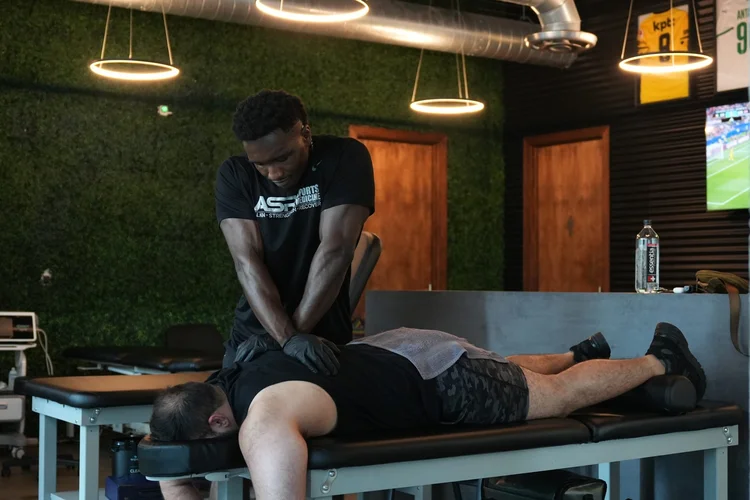
Early on we respect healing tissue: a short period of protection, gentle motion in safe ranges and isometric strengthening. We avoid the combined raised and rotated-out position until the shoulder is ready.
Then we build rotator cuff, shoulder blade and whole-arm strength, add stability drills in weight bearing and overhead, and finish with sport-specific work. If your surgeon recommends a stabilization procedure, we take you through that protocol instead.
What to expect
Tell us what is going on
Where it hurts, how it started and what you need to get back to. Booking is online or by phone, and you do not need a referral.
A full evaluation
Your clinician tests movement, strength and the joints and tissues involved to find what is driving your shoulder instability.
Treatment the same day
When it is appropriate, hands-on treatment and your first exercises start at the first visit.
A plan you can follow
You leave knowing what to do at home, what to ease off for now and what the next visits will cover.
Treatment at four Miami clinics
Physical therapy in Miami BeachBook Miami Beach
Physical therapy in BrickellBook Brickell
Physical therapy in Bal HarbourBook Bal Harbour
Physical therapy in Downtown MiamiBook Downtown Miami
Dislocated Shoulder questions
How long do I need to wear a sling?
Follow the physician who treated you. Sling time varies with age, the injury and whether surgery is planned.
Will I need surgery after a first dislocation?
Not always. It depends on your age, sport and what was damaged. Young athletes in contact or overhead sports are more often advised to consider it. An orthopedic surgeon makes that call, usually with an MRI.
Is a dislocated shoulder the same as a separated shoulder?
No. A dislocation involves the ball and socket joint. A separated shoulder is an injury to the joint between the collarbone and shoulder blade.
Is every visit one-on-one?
Yes, if that is what you book. Chiropractic visits are always one-on-one. For physical therapy, a one-on-one visit is you and your physical therapist for the full session. We also offer a shared physical therapy session, where your physical therapist works with you and one other patient, at a lower rate. It is never more than two patients, and the choice is yours.
Do you take insurance?
Yes, on an out-of-network basis. You pay at the time of service and we give you a superbill to submit to your plan. If you prefer, we submit the claim for you and refund the difference when your plan reimburses.
Do I need a referral?
No. You can book directly. If your case needs imaging or a physician's evaluation, we will tell you and help you arrange it.
GET BACK TO WHAT YOU LOVE
Pick the clinic closest to you, or call and we will help you choose where to start.
BOOK ONLINEInsurance and pricing: We accept insurance on an out-of-network basis. Current pricing is available by phone or at booking.
This page is general information, not medical advice. Your clinician will tell you what applies to you at your evaluation.
ASR Sports Medicine · Miami Beach · Brickell · Bal Harbour · Downtown Miami · (305) 984-1155